
How to Choose Artificial Topiary Trees for Your Front Door: Size, Style & Pairing
Choosing the right artificial topiary trees for your front door involves more than picking a style you like. The height, foliage shape, planter size, and number of trees all influence how balanced your entrance looks.
Quick Answer: For a smaller entrance, a single 3–4 ft artificial topiary can add greenery without taking up too much space. For a wider doorway, a matching pair of 4–5 ft trees can create a more symmetrical display. Classic Cedar offers a structured, tapered silhouette, Weeping Cedar features layered evergreen foliage, and Soft-Touch Cypress provides a slender tower-shaped alternative.
Before choosing, measure your available floor space, check the foliage width, and confirm whether the selected product includes a planter or ground spike.
This guide explains how to choose the right artificial topiary for your entrance, with practical comparisons and actual product specifications from Vitalismo.

One Artificial Topiary Tree or a Matching Pair?
The number of trees you choose can change the entire appearance of your entrance. A single topiary creates a simple focal point, while two matching trees can frame a doorway and establish a more symmetrical look.
Neither arrangement is automatically better. Consider the architecture and available space before deciding.
When One Topiary Tree Is Enough
A single artificial topiary is often the better choice for a compact porch, narrow doorway, or asymmetrical entrance.
For example, if one side of your door has a wall, window, bench, or decorative lantern, placing a tree on the opposite side can create visual balance without overcrowding the space.
A single tree also works well beside a garage entrance, along a covered walkway, or near an outdoor seating area.
Consider one tree if:
- Your entrance has limited floor space.
- There is more available room on one side of the doorway.
- You prefer a simple, understated look.
- Existing planters or outdoor furniture already provide visual balance.
A 3 ft or 4 ft artificial cedar can be a useful starting point for these arrangements, depending on its foliage spread and planter footprint.
When Two Matching Trees Work Better
For a wider entrance with a centered doorway, a matching pair can create a more complete and coordinated appearance.
Place one tree on each side of the door, keeping their distance from the entrance and surrounding furniture consistent.
Two trees are particularly suitable for:
- Double front doors.
- Wide covered porches.
- Symmetrical entryways.
- Larger homes with substantial entrance areas.
Vitalismo's Artificial Classic Cedar Topiary Trees are offered as a matching two-tree set, making them a convenient option for symmetrical arrangements.
The Artificial Weeping Cedar Tree also offers one-tree and two-tree quantity options.
A useful decorating principle: Don't choose two trees simply because matching pairs look attractive in photographs. Make sure both trees fit comfortably without narrowing the walkway or interfering with the door.
What Size Artificial Topiary Tree Should You Choose?
Height is one of the first things to consider when buying artificial topiary trees for a front entrance. However, the overall width of the foliage and the size of the planter are equally important.
A tall, narrow tree can fit into a space where a shorter but wider tree might feel crowded.
A Practical Height Guide
Tree Height Suggested Placement Overall Look
3 ft Compact porches and small entryways Subtle greenery
4 ft Standard residential entrances Balanced focal point
5 ft Wider doorways and spacious porches More noticeable greenery
6 ft Large entrances and open spaces Strong vertical presence
These are general styling recommendations rather than fixed measurements for every home.
For a compact entrance, start by comparing 3 ft and 4 ft options. If your doorway has more surrounding space, consider 5 ft or 6 ft designs.
Check the Actual Dimensions Before Buying
The listed tree height does not tell you everything about the space a topiary will occupy.
Before ordering, check:
- Overall height: Make sure the tree fits comfortably beneath nearby architectural features.
- Foliage width: Consider how far the branches extend on either side.
- Planter dimensions: Check whether the base will fit beside the doorway.
- Walking clearance: Leave enough room for the door to open and people to pass comfortably.
For example, Vitalismo's Weeping Cedar series provides the following published specifications:
Tree Height Listed Leaf Count Planter Dimensions
3 ft 453 6.0 × 6.0 × 5.1 in
4 ft 659 6.0 × 6.0 × 5.1 in
5 ft 907 6.0 × 6.0 × 5.1 in
6 ft 1,339 7.7 × 7.7 × 6.7 in
These figures are specific to this Weeping Cedar product. The leaf count is a published product specification, not a direct measurement of visual fullness.
For shoppers who want a narrower silhouette, Vitalismo's Soft-Touch Tower Cypress also provides useful width measurements:
Tree Height Approx. Foliage Width Planter Diameter
2 ft 11.8 in 5.5 in
3 ft 11.8 in 7.0 in
4 ft 14.6 in 8.6 in
5 ft 15.7 in 8.6 in
6 ft 25.2 in 8.5 in
Measurements are approximate. Foliage width refers to the approximate spread of the branches, while planter diameter is measured at the top opening.
One important detail: Check whether the listed tree height includes the planter. Product specifications can present tree height and planter dimensions separately, so always review the selected variant's complete dimensions.
Classic Cedar vs. Weeping Cedar vs. Tower Cypress
Although these artificial evergreens share a similar tapered appearance, their foliage structure and overall styling are different.
Understanding those differences makes it easier to choose a tree that complements your home's exterior.
Classic Cedar: A Structured Evergreen Shape
Classic Cedar is a good choice for homeowners who prefer a neat, traditional topiary appearance.
Its layered, staggered branches create a slim conical silhouette that works particularly well beside symmetrical entrances, traditional homes, and formal porch designs.
Vitalismo's Artificial Classic Cedar Topiary Trees feature PE foliage and a detachable two-section design. The matching set includes two trees and two black planters.
This style is worth considering if you want:
- A coordinated pair beside your front door.
- A structured, tapered evergreen appearance.
- A traditional look that works beyond Christmas.
- A relatively straightforward decorating arrangement.
Weeping Cedar: Layered and Naturally Inspired
Weeping Cedar offers another interpretation of the classic evergreen topiary.
Vitalismo's Weeping Cedar features dense, layered PE foliage and a naturally tapered silhouette. Its branching arrangement gives the tree a different visual character from the more structured Classic Cedar design.
It is a good option for homeowners who want a softer-looking evergreen accent without moving away from a traditional cedar shape.
The series is available in multiple heights and offers one-tree and two-tree configurations, allowing you to choose an arrangement that suits your entrance.
Explore the Vitalismo Artificial Weeping Cedar Tree.
Soft-Touch Tower Cypress: A Slimmer Alternative
If your entrance has limited horizontal space, a tower-shaped cypress may be worth considering.
Vitalismo's Soft-Touch Artificial Tower Cypress features TPE foliage with a softer feel and a classic tapered silhouette.
It is available in heights from 2 ft to 6 ft, with single-tree and matching-pair options.
Its measured foliage width can help shoppers compare different sizes before purchasing, especially when placing trees beside narrow doorways or furniture.
Which Style Should You Choose?
Style Foliage & Shape Best Suited To
Classic Cedar Layered branches, structured conical silhouette Formal and symmetrical entrances
Weeping Cedar Dense, layered evergreen foliage Natural-looking porch arrangements
Tower Cypress Soft-touch TPE foliage, tapered tower shape Narrow entrances and compact spaces
The distinction is not simply about which tree looks more realistic. It is about choosing the silhouette, foliage material, and proportions that best suit your space.

Black Planter or Ground Spike: Which Base Should You Choose?
The base determines where an artificial topiary can be positioned and how it is displayed.
For front entrances, the two most common considerations are a freestanding planter and a ground-spike design.
Black Planters for Porches and Hard Surfaces
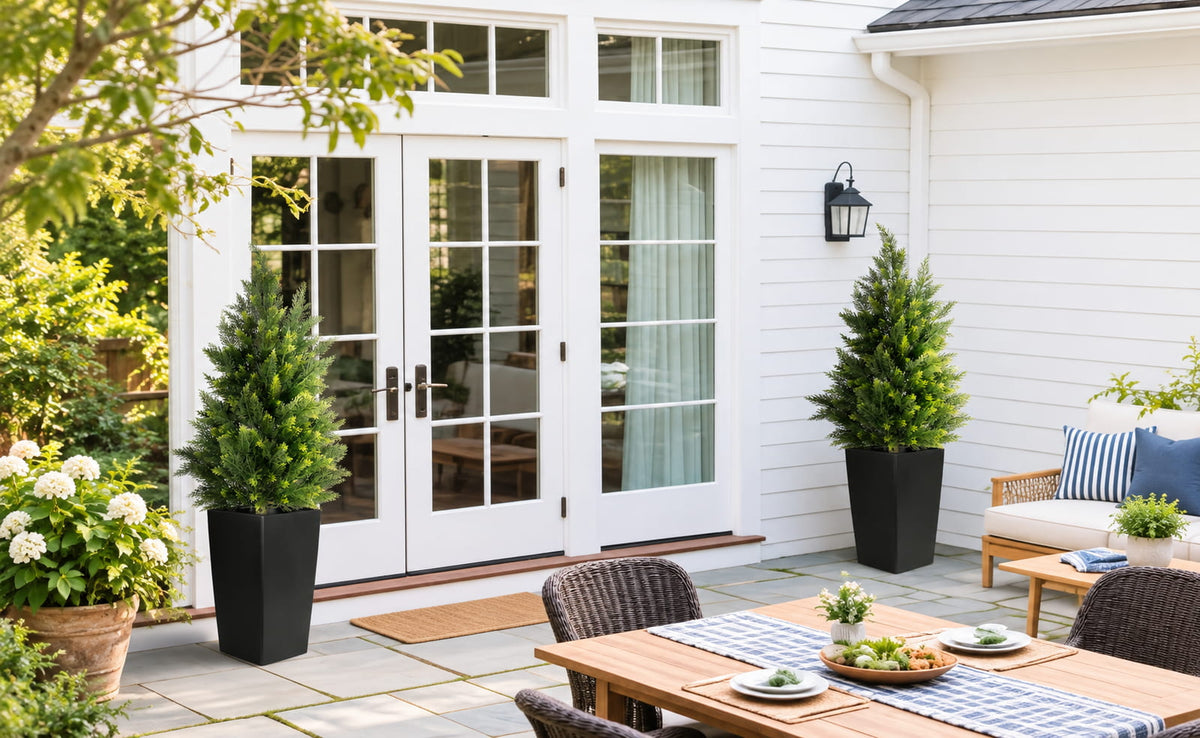
A potted artificial topiary is generally the more convenient option for tiled entrances, concrete porches, covered patios, and indoor entryways.
The planter provides a defined base and allows the tree to be positioned without inserting anything into the ground.
Vitalismo's Classic Cedar, Weeping Cedar, and Soft-Touch Cypress product lines include selected configurations with black planters.
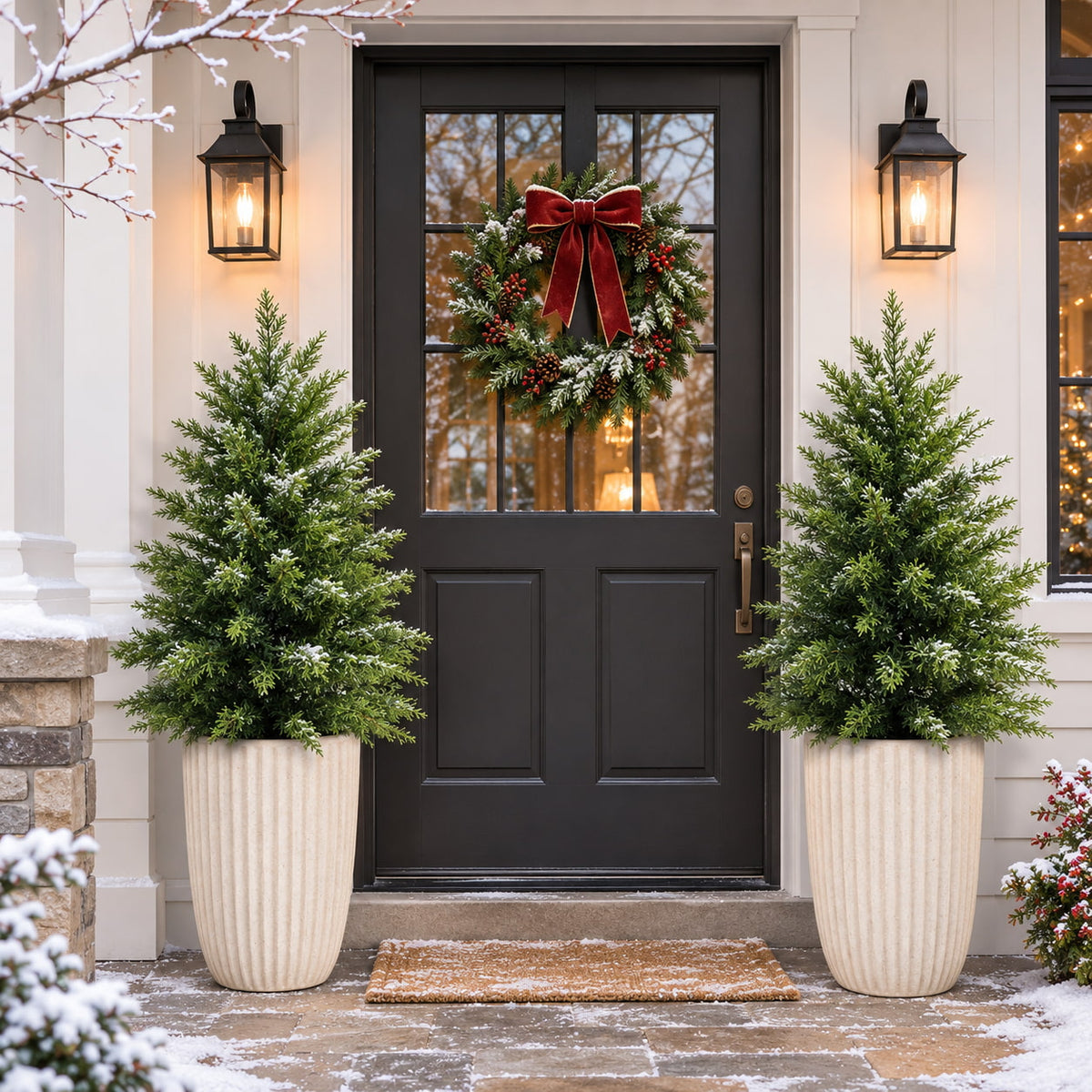
A black planter also works well with neutral exterior colors, stone surfaces, white siding, and darker front doors.
Before choosing a potted tree, check:
- Whether the selected variant includes a planter.
- The planter's width and height.
- Whether the planter provides enough stability for the intended location.
- Whether you plan to place it inside a larger decorative container.
For exposed or windy locations, consider the stability of the complete arrangement rather than relying on the planter alone.
Ground Spikes for Garden Beds and Landscaped Entrances
A ground-spike design is intended for insertion into suitable soil.
It can be useful along garden borders, landscaped walkways, and outdoor entrance areas where a freestanding planter is unnecessary.
Vitalismo's 2 ft Artificial Spiked Weeping Cedar Tree offers two base styles: Spiked and Potted.
This particular product uses weather-resistant, UV-stabilized PE foliage and is designed for outdoor landscaping applications.
Choose the ground-spike version when you have suitable soil for insertion. Choose the potted version when placing the tree on a porch, patio, or other hard surface.
Planter vs. Ground Spike
Consideration Black Planter Ground Spike
Concrete or tiled surfaces Suitable Not suitable for direct insertion
Covered front porch Suitable Only if suitable soil is available
Garden beds Can be used Designed for soil insertion
Repositioning Generally easier Requires removal and reinsertion
Appearance Defined decorative base More integrated with the landscape
Remember that not every Vitalismo cedar product has both base options. Always check the specific product and selected variant before ordering.
Styling Artificial Topiary Trees for Christmas and Everyday Decor
Artificial evergreen topiaries can work beyond the holiday season.
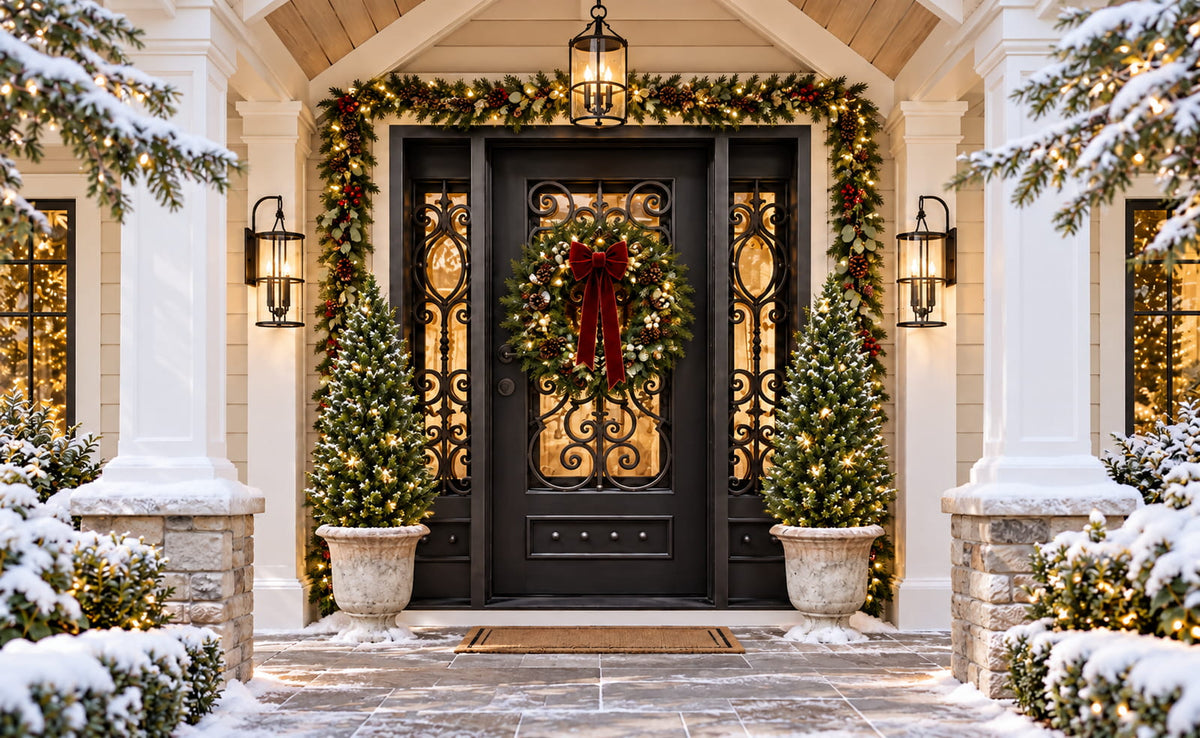
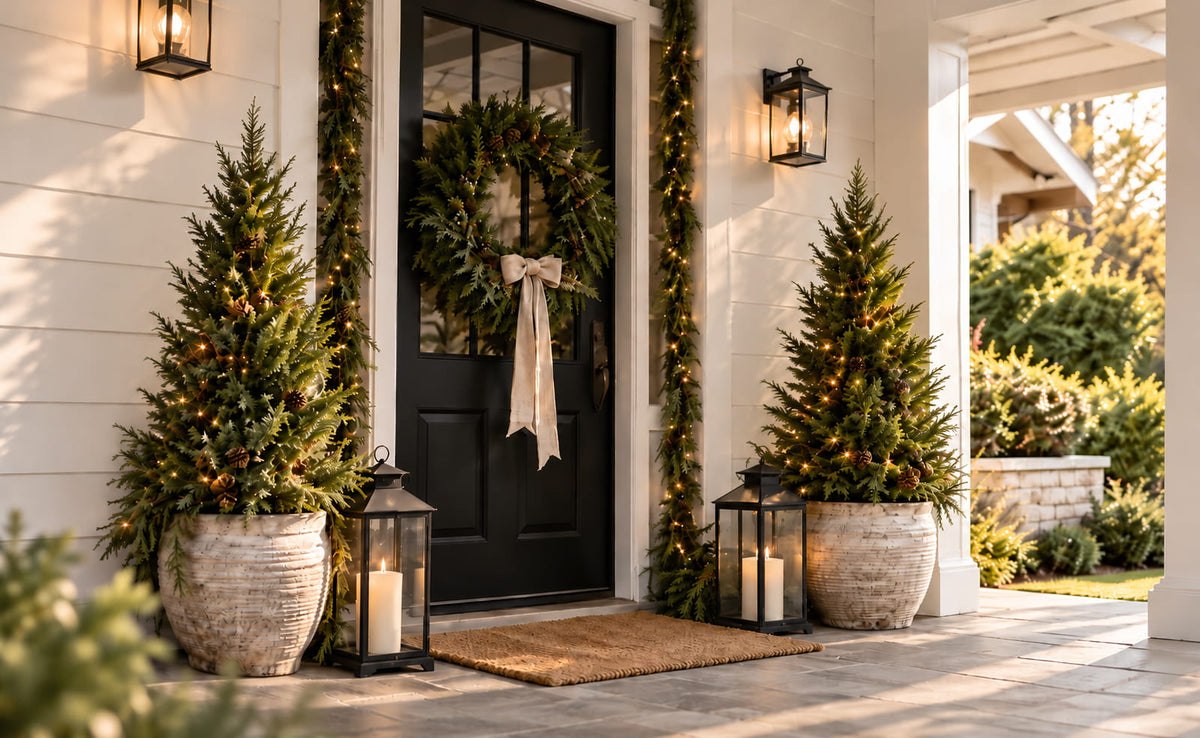
During Christmas, a matching pair of cedar trees can frame a front door alongside a wreath, decorative lanterns, or subtle seasonal accents.
For a traditional holiday look, consider:
- Warm white decorative lights.
- Simple red or neutral ribbons.
- Natural-looking wreaths.
- Small seasonal accents that do not hide the foliage.
Keep the decorations proportional to the tree. The evergreen shape should remain the main visual feature.
After Christmas, remove the seasonal accessories and keep the trees as everyday greenery.
Classic Cedar can complement a more structured exterior, while Weeping Cedar and Cypress offer alternative evergreen silhouettes for different architectural styles.
For year-round use, consider the product's recommended placement and material specifications. The 3–6 ft Weeping Cedar and Soft-Touch Cypress product pages recommend sheltered outdoor locations and caution against prolonged direct sunlight, heavy rain, and strong winds.
The 2 ft Spiked Weeping Cedar is a separate product with its own UV-stabilized, weather-resistant PE specifications. Do not assume that every artificial cedar has the same outdoor rating.
Common Mistakes to Avoid When Choosing Front Door Topiary Trees
A well-chosen topiary should complement your entrance rather than compete with it.
A few common purchasing mistakes are worth avoiding.
Choosing by height alone
A 5 ft tree may seem like the obvious choice, but a wide canopy can occupy more space than expected. Check both height and foliage width.
Buying a matching pair without measuring
Two trees create symmetry only when they fit comfortably. Make sure there is enough space on both sides of the door.
Overlooking planter dimensions
The tree may fit, but the planter could take up too much floor space. Compare the complete base dimensions before ordering.
Selecting the wrong base
A ground spike is designed for soil, not concrete or tile. Choose a potted version for hard surfaces.
Assuming all artificial trees are weatherproof
Outdoor suitability varies between products. Check the specific foliage material and placement recommendations before leaving a tree exposed to the elements.
Forgetting about door clearance
Make sure the tree does not interfere with the door swing, steps, handrails, or normal walking paths.
Frequently Asked Questions
Should I buy one or two artificial topiary trees for my front door?
A single tree works well for smaller or asymmetrical entrances. A matching pair is generally better for wider, centered doorways where there is sufficient space on both sides.
What size artificial topiary is best for a front entrance?
A 3 ft or 4 ft tree can be a useful starting point for compact entrances, while 5 ft or 6 ft trees can create a stronger display in larger spaces. Compare the actual foliage width and planter dimensions before choosing.
What is the difference between Classic Cedar and Weeping Cedar?
Classic Cedar has a structured, staggered conical silhouette. Weeping Cedar features dense, layered foliage and a naturally tapered appearance. Both offer evergreen styling, but their branch arrangements create different visual effects.
Is artificial cypress suitable for a narrow front entrance?
It can be. Vitalismo's Soft-Touch Tower Cypress has a tapered silhouette and published foliage-width measurements, making it easier to compare available sizes for compact spaces.
Should I choose a potted topiary or a ground-spike tree?
A potted topiary is generally better for porches, patios, and hard surfaces. A ground-spike design is intended for suitable soil, garden beds, and landscaped areas.
Can artificial cedar trees stay outside all year?
Outdoor suitability depends on the specific product. Some models are recommended for sheltered outdoor areas, while certain products have separate UV-stabilized foliage specifications. Always follow the individual product's placement and care recommendations.
Do artificial topiary trees need regular maintenance?
They do not require watering, pruning, or fertilizing. Occasional dusting and gentle cleaning can help maintain their appearance. Follow the manufacturer's instructions when cleaning the foliage.
Find the Right Artificial Topiary for Your Front Door
Choosing the right artificial topiary comes down to understanding your space and selecting the appropriate height, shape, quantity, and base.
A single tree can be enough for a compact entrance, while a matching pair can create a more symmetrical appearance. Classic Cedar offers a structured evergreen shape, Weeping Cedar provides layered foliage, and Soft-Touch Cypress gives you another tapered option for narrower spaces.
Vitalismo offers a range of Artificial Cedar and Cypress Trees with different sizes, foliage styles, and planter configurations.
Compare the actual dimensions, check the selected variant, and choose the design that complements your home.
A thoughtfully selected artificial topiary can bring a welcoming touch of evergreen greenery to your entrance, not just during Christmas, but throughout the year.
By Vitalismo Editorial Team
Practical guides for choosing and styling artificial greenery in everyday spaces.


Leave a comment
This site is protected by hCaptcha and the hCaptcha Privacy Policy and Terms of Service apply.