


Most Realistic Artificial Christmas Trees: Foliage, Shape and Fullness Explained
The most realistic artificial Christmas trees combine three-dimensional needle textures, subtle color variation, naturally arranged branches, and balanced fullness. Rather than relying on branch count alone, the best-looking designs recreate the irregular shapes, layered greenery, and natural shadows found in real evergreens.
A tree may look impressive in a professionally styled product photo but appear less convincing when viewed up close. That is why examining foliage construction and branch distribution is just as important as comparing overall size.
In this Vitalismo guide, we'll explore the finer details that separate ordinary artificial Christmas trees from genuinely lifelike designs and explain how to evaluate their appearance before buying.

5 Details That Make an Artificial Christmas Tree Look Real
When comparing realistic artificial Christmas trees, focus on five visual characteristics: needle structure, color variation, branch arrangement, foliage density, and overall silhouette.
Each contributes to a different aspect of realism.
| Realism Factor | What to Look For | What to Watch Out For |
|---|---|---|
| Needle structure | Defined, dimensional needle shapes | Flat, repetitive foliage |
| Color variation | Subtle differences in green tones | Unnaturally uniform or overly glossy greenery |
| Branch arrangement | Varied lengths, angles, and layers | Identical, evenly spaced branches |
| Foliage density | Natural depth with balanced coverage | Large empty gaps or excessive uniformity |
| Tree silhouette | Gradual taper with organic edges | A perfectly symmetrical, cone-like outline |
A convincing artificial Christmas tree should perform well across these characteristics rather than excel in only one.
For example, realistic needles cannot completely compensate for an unnatural silhouette, just as a full tree may still look artificial if every branch appears identical.
PE vs PVC Christmas Trees: Why Foliage Construction Matters
Polyethylene (PE) and polyvinyl chloride (PVC) are two common materials used in artificial Christmas tree foliage.
However, the material name alone does not tell you exactly how realistic a tree will look. Needle construction and placement also matter.
PE Foliage: Three-Dimensional Needle Detail
PE needles are commonly molded to recreate the shape and structure of real evergreen foliage.
Unlike traditional flat-cut needles, molded foliage can reproduce more defined needle profiles, curved shapes, and dimensional branch details.
These characteristics are particularly noticeable near the outer edges of the tree, where individual needles are more visible.
PVC Foliage: Volume and Interior Coverage
Traditional PVC foliage is typically made from thin, cut material that creates a softer, more uniform texture.
While it may appear less natural at close range, PVC can help fill interior spaces and reduce the visibility of the central trunk and supporting structure.
Its visual effectiveness depends partly on where it is placed within the tree.
| Characteristic | Molded PE Foliage | Traditional PVC Foliage |
|---|---|---|
| Needle appearance | Dimensional and defined | Flat and fine |
| Close-up realism | Generally higher | More traditional artificial appearance |
| Visual texture | Structured | Soft and bushy |
| Common placement | Visible outer branches | Interior coverage or traditional foliage |
| Typical advantage | Needle-level realism | Fullness and affordability |
Some artificial Christmas trees combine molded and traditional foliage to create a balance between realistic outer branches and interior volume.
When shopping, examine the visible foliage rather than relying exclusively on advertised material percentages.
Also, remember that mixed foliage describes variation in foliage appearance. It does not necessarily indicate a specific PE-to-PVC material ratio.

Why Mixed Foliage Can Look More Natural
Real evergreen foliage is rarely visually identical throughout an entire tree. Differences in needle direction, branch growth, and foliage density create subtle variations across its surface.
Artificial trees that rely heavily on a single repeated branch pattern may lack this natural complexity.
Mixed foliage introduces a wider range of visual forms. Different foliage shapes and overlapping branches help break up repetitive patterns, allowing the tree to appear more organic.
There are three important visual advantages.
Texture variation: Different foliage profiles make individual branches more distinguishable.
Visual depth: Overlapping greenery creates stronger separation between foreground and interior branches.
Surface variation: Differences in foliage shape and direction prevent the entire tree from appearing uniformly flat.
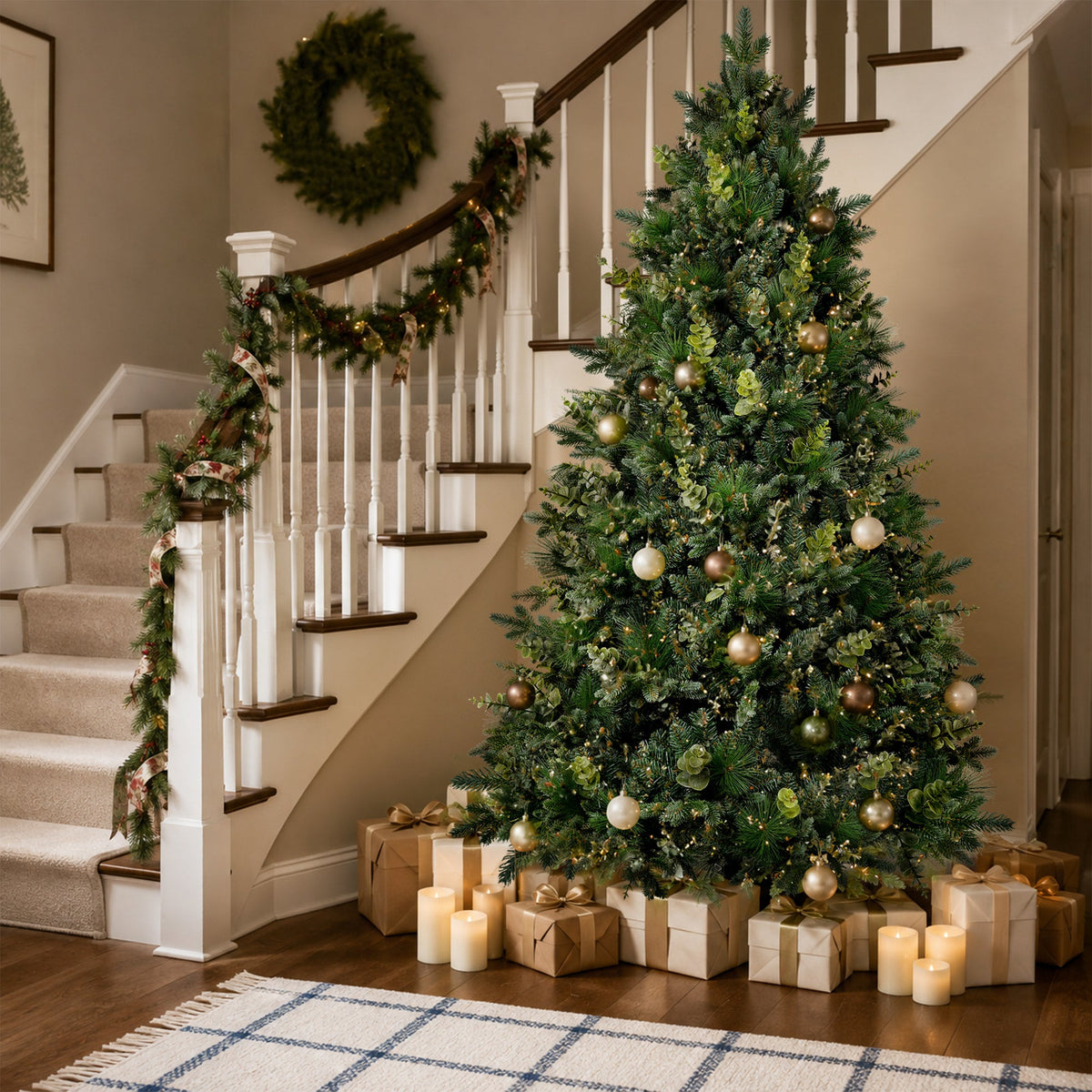
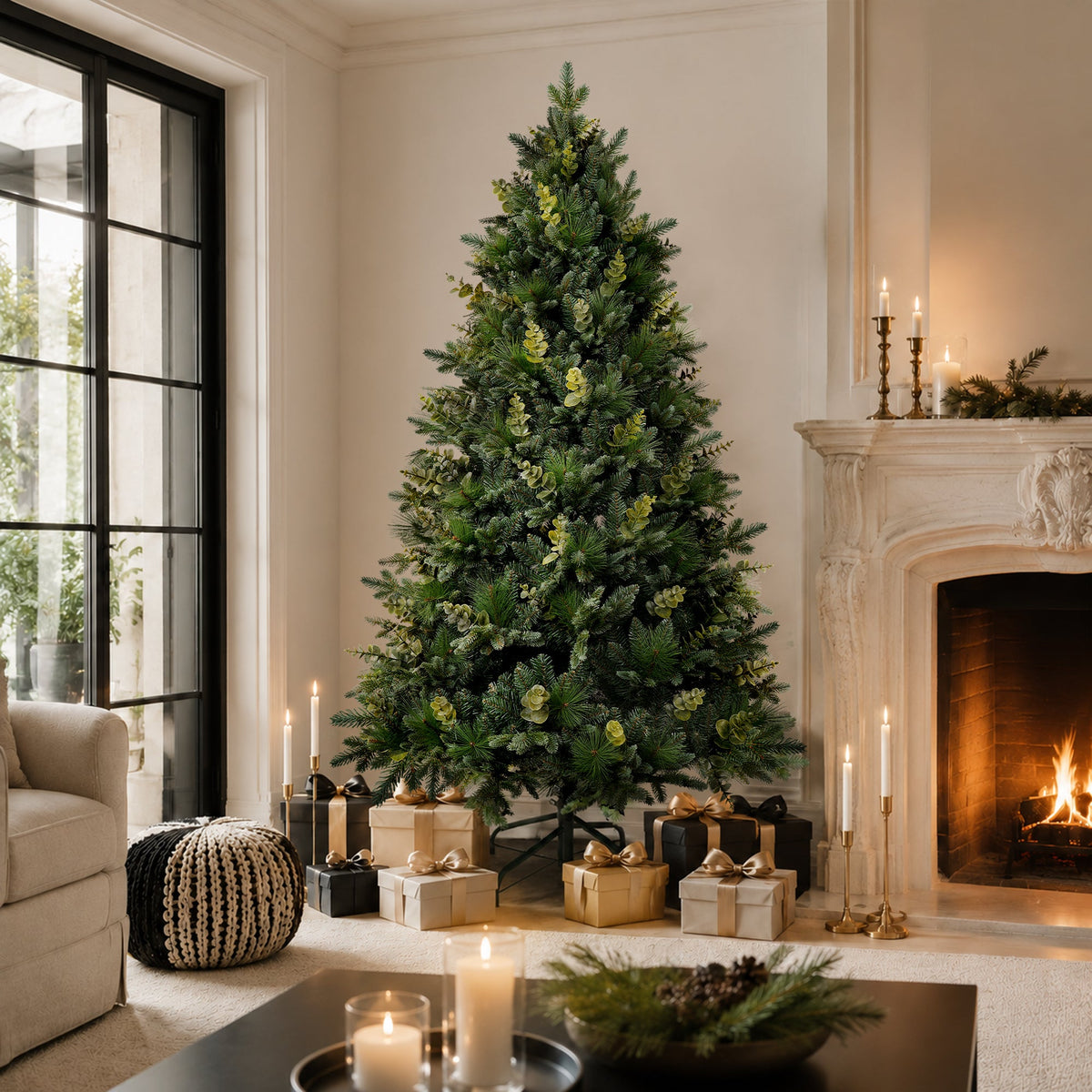
Vitalismo's 7 FT Mixed Foliage Artificial Christmas Tree uses varied evergreen foliage and layered branches to create a full silhouette with visible texture.
This makes it an appealing option for homeowners who want greenery itself to remain an important part of their holiday display, rather than covering every branch with ornaments.
Is a Higher Branch Tip Count Always Better?
A higher branch tip count does not automatically make an artificial Christmas tree more realistic.
Tip count indicates the number of branch tips, but it does not describe their size, construction, placement, or visual distribution.
Two trees with similar tip counts can look noticeably different if one has longer, more dimensional branches while the other uses smaller, uniformly arranged tips.
A naturally full Christmas tree should balance three characteristics:
-
Exterior coverage: Enough visible greenery to create a substantial silhouette.
-
Interior depth: Layered foliage that reduces distracting views of the supporting structure.
-
Natural spacing: Small openings and differences in branch length that prevent the tree from resembling a solid green cone.
Purposeful spaces between branches can also provide room for ornaments without hiding the surrounding foliage.
Rather than selecting the tree with the highest advertised tip count, look for a balanced combination of fullness and natural branch definition.
The Three-Distance Test: How to Judge Christmas Tree Realism
One practical way to evaluate an artificial Christmas tree is to examine it from three different viewing distances.
Whether you are shopping online or looking at a tree in person, each distance reveals different aspects of its construction.
| Viewing Distance | What to Examine | Signs of a Natural Appearance |
|---|---|---|
| Close-up: 1–2 feet | Needle shape, surface finish, branch connections | Defined foliage, subtle texture, limited artificial-looking shine |
| Mid-range: 3–6 feet | Branch layers, density, visual depth | Varied branch direction and balanced greenery |
| Across the room: 8–12 feet | Overall silhouette and proportions | Natural taper, organic edges, balanced shape |
These distances are practical viewing suggestions, not formal testing standards.
Close-Up: Look Beyond the Green Color
Natural-looking foliage should offer more than a convincing shade of green.
Look for clearly defined needles, believable branch details, and a surface finish that does not appear excessively glossy under ordinary daylight.
Mid-Range: Look for Depth Rather Than Maximum Density
At a typical decorating distance, pay attention to how the branches overlap.
A tree with visible layers and varied foliage can create more visual depth than one whose branches form a continuous, uniform surface.
Across the Room: Evaluate the Silhouette
From farther away, individual needle details become less noticeable. Overall proportions and branch distribution become more important.
The tree should gradually narrow toward the top without looking excessively geometric or mechanically symmetrical.
A lifelike artificial Christmas tree balances these three viewing experiences instead of depending on one carefully arranged camera angle.
How to Evaluate Product Photos Before Buying
Online shoppers cannot always examine a Christmas tree in person, but the right product images can reveal important details.
Look for an undecorated full-tree photo, a close-up foliage image, and a side-angle or naturally lit lifestyle photo.
An undecorated image reveals the tree's actual shape. Close-up photography shows needle texture, while side-angle images help you understand how the branches are layered.
Be cautious when a product is shown exclusively with heavy decorations, bright lights, or dramatic filters. These elements can make it difficult to evaluate the foliage underneath.
If available, customer photos and videos offer another useful perspective on how a tree may look in ordinary homes.
A Realistic Mixed Foliage Christmas Tree from Vitalismo
For homeowners looking for a substantial holiday centerpiece with varied needle textures and layered greenery, the Vitalismo 7 FT Mixed Foliage Artificial Christmas Tree combines a full silhouette with a dimensional evergreen appearance.
| Product Feature | Details |
|---|---|
| Product | Vitalismo 7 FT Mixed Foliage Artificial Christmas Tree |
| Height | Approximately 83.5 inches (212 cm) |
| Width | Approximately 54.7 inches (139 cm) |
| Foliage | Mixed evergreen foliage |
| Silhouette | Full and layered |
| Lighting | Unlit |
| Construction | Sectional assembly |
| Stand | Metal stand included |
| Placement | Indoor spaces |
What distinguishes the mixed-foliage design is its combination of varied greenery and a substantial tree shape. Rather than focusing on a single uniform foliage texture, the design creates visual interest through layered branches.
Its fuller appearance is particularly well suited to spacious living rooms, large entryways, and holiday displays where the tree is intended to be the main decorative feature.
If you prefer a tree that showcases the greenery itself, explore the Vitalismo realistic artificial Christmas tree.

Please note: The tree and metal stand are included. Lights, ornaments, ribbons, and other decorative accessories are not included.
For help comparing different tree styles and choosing the right size for your space, read our artificial Christmas tree buying guide.
Frequently Asked Questions
What is the most realistic-looking artificial Christmas tree?
The most realistic-looking artificial Christmas trees combine dimensional needles, subtle color variation, naturally arranged branches, and balanced fullness. No single material or branch tip count guarantees the most lifelike appearance.
Are 100% PE Christmas trees always more realistic?
Not necessarily. Molded PE foliage can provide excellent needle-level detail, but color, branch distribution, silhouette, and interior fullness also affect realism. A well-designed mixed-material tree may provide an effective balance of these features.
What is the difference between mixed foliage and mixed-material Christmas trees?
Mixed foliage refers to different foliage shapes, textures, or visual styles within a tree. Mixed-material construction refers to the use of more than one material, such as PE and PVC. The two terms are not interchangeable.
How can I tell if an artificial Christmas tree is high quality?
Examine close-up foliage images, branch connections, overall shape, and density. A quality artificial Christmas tree should have believable greenery, a balanced silhouette, and a sturdy supporting structure.
Do artificial Christmas trees look more realistic with lights?
Lights can enhance visual depth and create a warmer atmosphere, but they do not replace realistic foliage construction. An artificial Christmas tree should have an appealing natural appearance even before lights are added.
Is the Vitalismo Mixed Foliage Christmas Tree pre-lit?
No. The Vitalismo 7 FT Mixed Foliage Artificial Christmas Tree is unlit and comes with a metal stand. You can personalize the tree with your own lights and holiday decorations.
Realism Is More Than Fullness
The most convincing artificial Christmas trees recreate the natural complexity of evergreen foliage rather than simply maximizing branch count or density.
Needle construction matters up close, layered foliage matters at decorating distance, and a balanced silhouette matters across the room.
By evaluating all three, you can make a more informed purchase and choose a tree that looks beautiful beyond the product photo.
Vitalismo's Mixed Foliage Christmas Tree brings together varied evergreen textures and a full, layered silhouette, offering a natural-looking foundation for holiday decorating.
By Vitalismo Editorial Team
Practical guides for choosing, styling, and enjoying realistic artificial greenery throughout the seasons.


Dejar un comentario
Este sitio está protegido por hCaptcha y se aplican la Política de privacidad de hCaptcha y los Términos del servicio.