

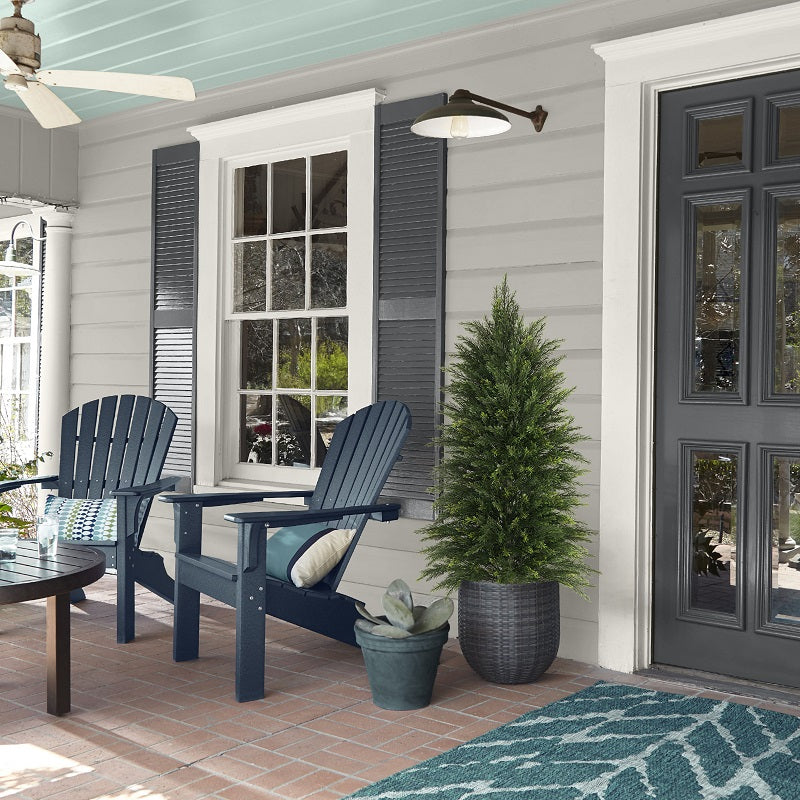
Award-Winning Artificial Cedar Tree Design | Vitalismo
What makes an artificial cedar tree feel truly realistic?
For Vitalismo, the answer starts with how real cedar trees actually grow. Their branches do not repeat at identical angles, their foliage is not one flat shade of green, and their overall shape is never perfectly uniform. What makes them feel natural is the balance between structure and variation.
That understanding informed our cedar design, which was recognized by the French Design Awards in the Interior Design – Home Decoration category.

Designed Around Natural Growth
A realistic artificial cedar tree should do more than look full.
Its silhouette should feel believable from a distance, while its smaller details should continue to hold up when viewed more closely. That means paying attention to how the crown narrows toward the top, how the lower branches become fuller, and how individual branches extend and fall in slightly different directions.
Rather than creating a rigid, repeated structure, the design focuses on a softer and more organic shape.
Color plays an important role as well. Real foliage naturally shifts between lighter and deeper greens depending on growth, light, and shadow. Using tonal variation helps create depth and prevents the tree from appearing flat.
The same applies to the trunk and branch surfaces. Subtle texture and variation help the overall form feel more grounded and less manufactured.

Together, these details create realism through proportion, movement, color, and texture rather than density alone.
What the Recognition Means
The French Design Awards is an international design competition recognizing work across a range of design disciplines.

Vitalismo’s cedar design was recognized in the Interior Design – Home Decoration category, reflecting the nature-inspired thinking behind the product.
For us, that recognition is meaningful because it highlights the design process rather than simply the finished appearance.
Artificial greenery is often treated as an accessory, but its effect on a room can be much broader. A well-proportioned cedar tree can soften an empty corner, add vertical balance beside furniture, or bring greenery into a space without making it feel crowded.
That is why we think about artificial plants not only as decorative objects, but as part of the visual structure of a home.
An Evergreen That Works Across Seasons
Cedar has a naturally versatile character.
In fall, an artificial cedar tree pairs easily with warm wood, woven textures, neutral fabrics, and understated seasonal accents. As winter approaches, the same evergreen shape can transition naturally into holiday styling with simple additions such as warm lights, ribbon, pinecones, or a nearby wreath.
Once those seasonal elements are removed, the cedar still works as year-round greenery.
This makes a faux cedar tree especially useful in living rooms, entryways, covered porches, balconies, and other transitional spaces where a consistent natural element can help the room feel more complete.
Artificial plants are not intended to replace the experience of growing living ones. What they offer is a different kind of flexibility: greenery that works in spaces where sunlight, maintenance, temperature, or seasonal conditions may be difficult to manage.
For Vitalismo, realistic artificial greenery comes down to a simple idea: the more carefully we observe nature, the less we need to exaggerate it.
A natural silhouette, subtle color variation, layered branches, and thoughtful proportion can do more than excessive fullness ever could.



Leave a comment
This site is protected by hCaptcha and the hCaptcha Privacy Policy and Terms of Service apply.